
iGaming runs on code that never sleeps. Sportsbook feeds update by the second, casino lobbies juggle thousands of game integrations, CRM engines fire bonuses around the clock, and every line has to clear compliance in several regulated markets at once. Shipping into that is hard. It is also the exact setting where a coding agent like Codex starts to look useful rather than gimmicky.
If you build software for an operator or a platform provider, you have heard the noise about AI writing code. Most of it skips the parts you actually care about. This piece covers what Codex is, how it behaves, what it costs, and where it pulls its weight inside a real iGaming stack, with worked examples rather than promises.
What Codex actually does
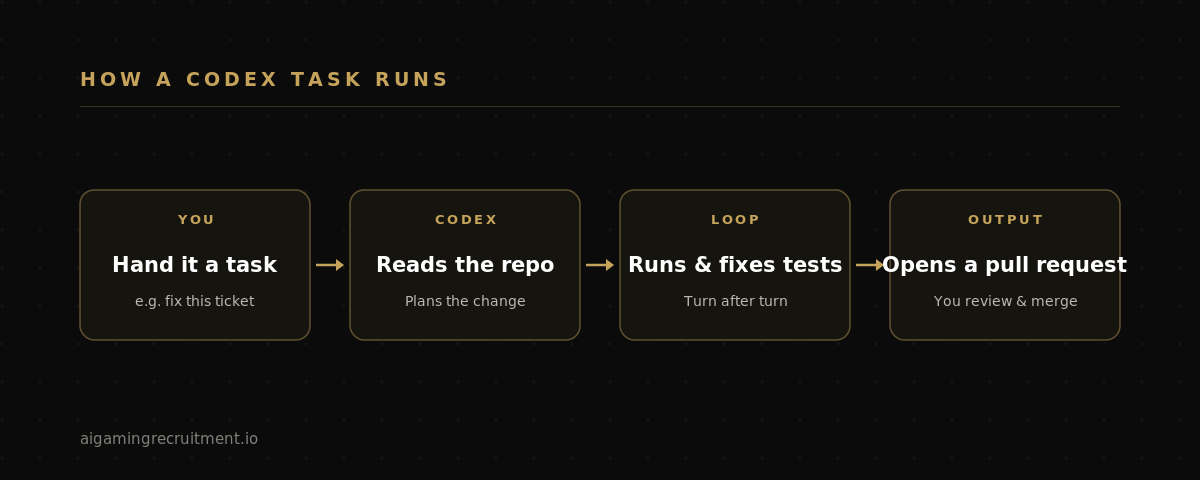
Older tools finished your line or suggested the next block while you stayed in control. Codex, OpenAI’s coding agent, takes a whole task off your plate. It reads your repository, works out the structure, runs the tests, fixes what fails, and opens a pull request for you to review.
That changes the unit of work. You used to feed the tool keystrokes. Now you hand Codex an outcome, something like “make this provider integration pass its test suite,” and it works the problem until it gets there or hits a wall. Your job moves from typing code to reviewing it. Think of Codex as a capable junior engineer you delegate to. It does the grind. You keep the architecture decisions and the merge button.
Codex is several tools sharing one engine. There is a terminal agent, a cloud mode that runs delegated tasks in isolated sandboxes, and plug-ins for editors like VS Code and Cursor. You can launch a handful of tasks in parallel and review them as they finish.
How the agent loop works
Codex runs a loop. You give it a task, it builds a prompt, the model responds. Often the response is an action rather than an answer: run this command, read this file, edit that module. Codex carries out the action, feeds the result back, and goes round again. Each round is a turn, and it keeps turning until the work is done.
One detail decides your cloud bill. Every follow-up replays the whole conversation back into the model, so longer tasks cost more. Codex softens that with caching. Stable content, like your project instruction files, goes at the front of the prompt and gets reused at roughly a tenth of the price. The lesson for an engineering team is dull but it saves money: keep your instruction files steady during a session. Rewrite them halfway through and you throw away the cheap cached prefix and pay full freight again.
Where Codex pays off in an iGaming stack
Codex is strongest on work that is well-defined, repetitive, and checkable by tests. iGaming codebases are full of that.
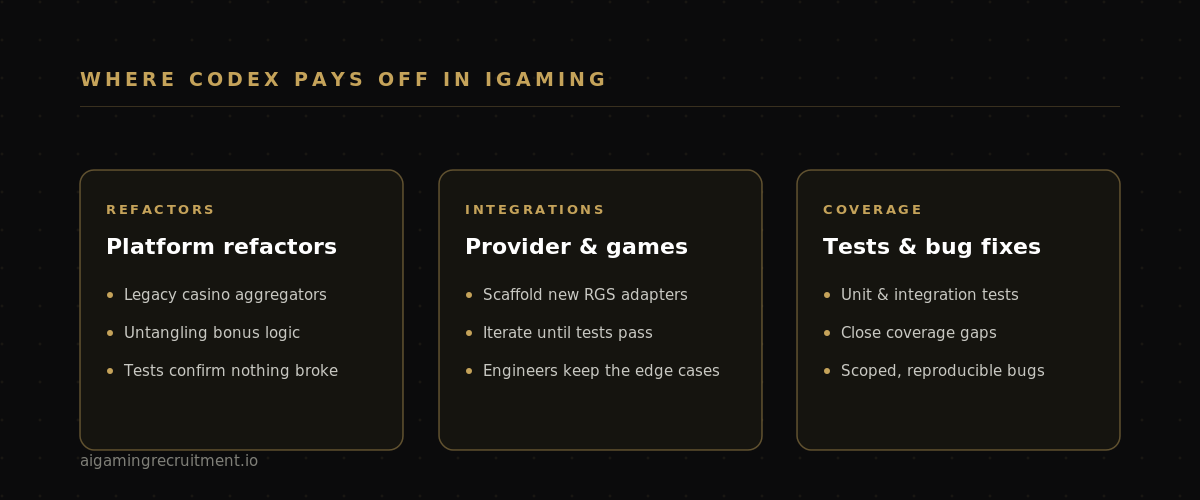
Platform refactors are the obvious win. Migrating a legacy casino aggregator or untangling years of bolted-on bonus logic is mechanical but enormous. Point Codex at it, let your test suite confirm nothing broke, and hand off the file-by-file slog that would cost an engineer days of dull work.
Provider and game integrations are another. Onboarding a new slots supplier or RGS usually means the same wiring, over and over, against a known spec. Codex can scaffold the integration, write the adapter, and iterate until the integration tests go green, leaving your engineers free for the genuinely awkward edge cases.
Test coverage suits it well, because Codex was trained to run tests and keep going until they pass. Ask it to generate unit and integration tests for a wallet service or a payments module, and you close the coverage gaps the team never finds time for.
Bug fixing is close to its sweet spot when the defect is scoped and reproducible. Give Codex a failing ticket with a clear repro and it can trace the cause, propose a fix, and return a pull request instead of a blank screen.
Documentation and onboarding round it out. Drop a new hire into a sprawling sportsbook codebase and their first week goes on orientation alone. Codex can explain unfamiliar modules in plain English and keep the docs current, which speeds up every change that comes after.
Where Codex will bite you
Codex is weakest exactly where iGaming is hardest: judgement, ambiguity, and rules that live outside the code. Treating it as magic is how teams get hurt.
Architecture calls, like how to shard a player wallet across regulated markets, need trade-offs the agent cannot see. Vague requirements are dangerous, because Codex will pick an interpretation with full confidence and build the wrong thing beautifully. Compliance and security-sensitive code is the big one. A plausible change to KYC logic or a payment flow can introduce a subtle, costly problem, and the agent has no idea it just crossed a regulatory line.
The failure modes follow from that. Codex can invent an API that looks right and does not exist. It can produce a silent error that sails through a thin test suite. And because the output reads so cleanly, it tempts everyone into trusting it too fast. The rule in a regulated industry is simple: verify in proportion to risk. A green test suite is necessary and never sufficient, and a human owns review on anything touching money, player data, or compliance.
What Codex costs
Codex bills on tokens, and the shape surprises teams used to flat monthly tools. A simple task might cost cents. A debugging session that loops twenty times costs real money, because each retry replays the full history. The fix is unglamorous: cap the number of turns and set token limits on automated runs so a flaky test cannot quietly run up a bill overnight.
The upside is measurable. One enterprise study reported review cycle times falling by about a third once an agent was pre-screening pull requests, with the most engaged developers shipping noticeably more code. For an operator where time-to-market on a new feature or a new jurisdiction decides the quarter, a third off your review cycle is not noise.
Codex versus the alternatives
A quick map, since you will hear these names together. ChatGPT and Copilot are assistants, good for inline help, but they do not own a task end to end. Cursor is an agentic editor for people who want autonomy without leaving the IDE. Claude Code is the nearest rival, usually more thorough and more token-hungry, where Codex tends to run leaner. Devin is the most hands-off and the most expensive. Pick on how much autonomy you want and where the tool fits into your workflow, not on a feature checklist.
Rolling it out without regret
Do not switch on Codex across forty repositories on day one. Pilot it with one team and a couple of low-risk, checkable jobs. Test generation and documentation are ideal, with human review mandatory. Invest in a clear project instruction file and a strong test suite, because together they make Codex both cheaper and safer. Treat the agent as a privileged identity: scope its repository access, keep secrets out of its reach, and log what it touches. Then track cost per task and review cycle time from the first week, and expand only when the numbers earn it.
iGaming has always rewarded teams that ship fast without breaking trust. Used with discipline, Codex takes the grunt work off your engineers and frees their judgement for the parts that decide whether a release is safe. The operators who learn to supervise these agents well will be the ones moving fastest, and that gap is only going to widen.
Want your team to build the skills to supervise tools like Codex well? OpenAI runs a free learning academy for businesses, a solid starting point.
FAQ
What is Codex?
Codex is OpenAI’s coding agent. Rather than autocompleting lines, it reads your repository, plans a task, runs the tests, fixes what fails, and opens a pull request for you to review.
How is Codex different from ChatGPT or Copilot?
ChatGPT and Copilot are assistants that help you inline while you stay in control. Codex owns a whole task from start to finish, working the problem until the tests pass or it hits a wall.
What does Codex cost?
Codex bills on tokens, so a simple task can cost cents while a long debugging loop costs more, because each turn replays the full history. Capping turns and setting token limits keeps automated runs predictable.
Is Codex safe for compliance-sensitive iGaming code?
Treat it with care. A green test suite is necessary but never sufficient, so a human must review anything touching money, player data or compliance before it ships.
Where should an iGaming team start with Codex?
Pilot it with one team on low-risk, checkable jobs like test generation and documentation, with mandatory human review, then expand as cost per task and review cycle time earn it.