
If you already work in iGaming, you do not need convincing that the pace is relentless. Product roadmaps shift weekly, CRM calendars never stop, campaigns need launching yesterday, and regulators keep everyone honest. This is a practical guide to Claude AI for iGaming professionals: AI is not going to do your job for you, but used properly it can take a meaningful chunk of the busywork off your plate and sharpen the work that is left.
This guide focuses on Claude, the AI assistant built by Anthropic, and how people in real iGaming roles can use it day to day. We will look at concrete examples for product managers, CRM executives, and digital marketing managers, and get into some of the more technical ways it earns its place in your workflow. Where it helps, we will compare Claude to other tools like ChatGPT and Gemini, but the focus throughout is Claude.
Why Claude AI for iGaming?
There are several capable AI assistants, so it is worth being clear about why Claude suits this kind of work. Anthropic built Claude with a strong emphasis on reliability and honesty, which in practice means it is more willing to flag uncertainty than to confidently invent an answer. When you are reasoning about player data, compliance wording, or financial reporting, that calibration matters.
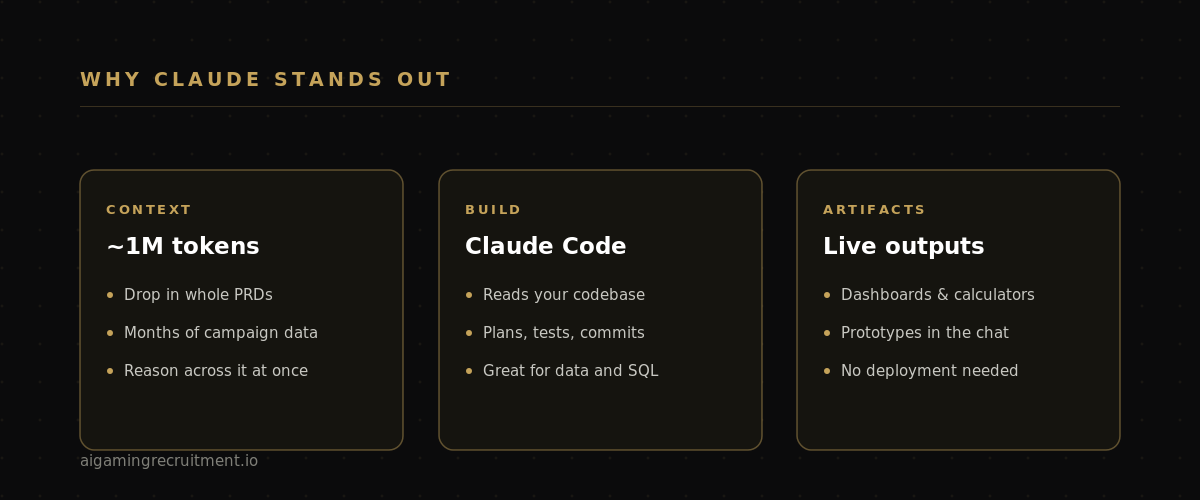
Claude also handles very large amounts of text in a single conversation, up to roughly a million tokens on its higher-tier models. In plain terms, you can drop in an entire product requirements document, a full set of campaign reports, or months of CRM performance data and have Claude reason across all of it at once, rather than feeding it piece by piece.
Two more features stand out for technical and semi-technical users. Claude Code is a terminal-based coding agent that can read a codebase, plan changes, run tests, and commit them, which is genuinely useful if your role touches data, SQL, or light scripting. Artifacts let Claude build live, interactive outputs such as dashboards, calculators, or prototypes directly inside the chat, with no deployment needed.
For comparison, ChatGPT adds image generation, which Claude does not currently offer, and Gemini is tightly integrated with Google’s apps and search. Many professionals use more than one. But for writing quality, long-document reasoning, and coding-adjacent work, Claude is a strong default.
For Product Managers
Product work in iGaming lives and dies on clarity, and clarity takes time. Claude compresses a lot of that.
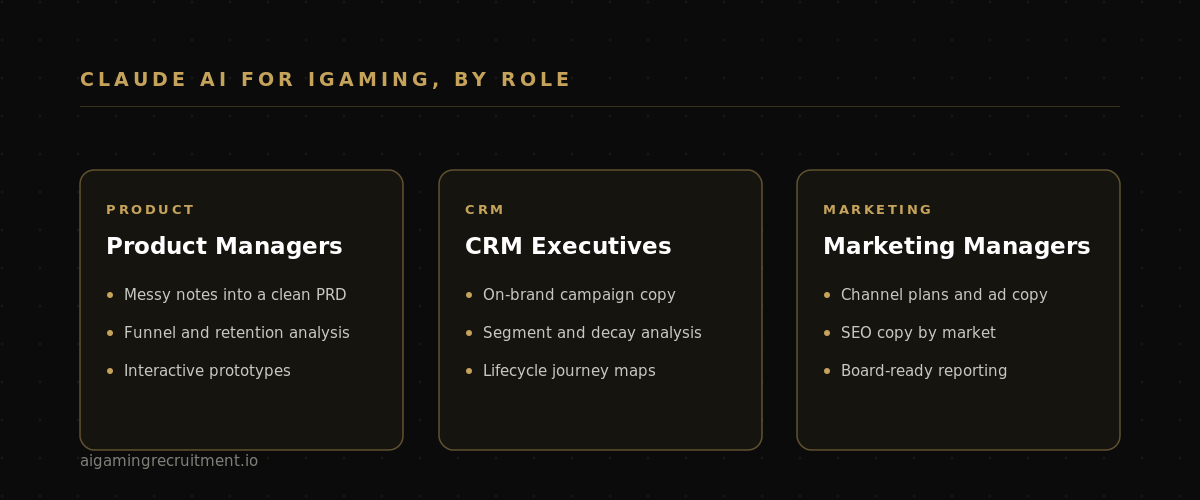
Start with documentation. Paste in messy meeting notes or a rough brief and ask Claude to turn it into a structured product requirements document with user stories and acceptance criteria. Because it handles long context well, you can give it the existing PRD alongside new feedback and ask it to reconcile the two and highlight conflicts.
It is also a fast second brain for prioritisation. Describe a backlog and the constraints, and ask Claude to lay out a RICE or MoSCoW view with its reasoning shown. You stay the decision maker; it just does the legwork and forces the trade-offs into the open.
On the more technical side, Claude is strong at reading and explaining code and data. If your engineers ship a change and you want to understand the implications, you can paste in the relevant snippet or a database schema and ask for a plain-English explanation. You can also ask it to draft the SQL for a quick funnel or retention query, then have it explain each clause so you actually learn the structure rather than just copying it. With Artifacts, you can ask Claude to mock up an interactive prototype of a feature flow to share with stakeholders before a single engineering hour is spent.
A simple example: “Here is our current registration funnel data and the new KYC step we are considering. Model the likely drop-off at each stage, flag the biggest risk, and draft three hypotheses we could A/B test.” You get a structured starting point in minutes, not hours.
For CRM Executives
CRM in iGaming is a content and segmentation machine, and both are areas where Claude shines.
For content, you can generate and refine campaign copy at speed while keeping your brand voice. Give Claude examples of your previous emails and push notifications and ask it to match the tone for a new promotion. Ask it to produce three subject line variants optimised for open rate, then a shorter version for SMS and an even tighter one for a push. Crucially, it is good at staying within constraints, so you can tell it to avoid specific responsible gambling triggers or to keep language compliant for a regulated market.
For segmentation and analysis, paste in your campaign performance export and ask Claude to summarise what is working, which segments are decaying, and where reactivation effort is best spent. Because it can hold a large dataset in context, you can compare several months of sends in one go and ask it to spot patterns you might miss scrolling a spreadsheet.
It is also a useful planning partner. Ask it to build a lifecycle journey map for a new player, from first deposit through to VIP, with suggested triggers, channels, and messaging at each stage. A practical prompt: “Design a 30-day reactivation journey for lapsed slots players who deposited at least three times. Include channel, timing, message angle, and a control group, and keep all messaging responsible-gambling compliant.” You get a ready-to-refine framework rather than a blank page.
For the more technical CRM executives, Claude can help draft the SQL behind a segment, explain how a particular query would behave, or sense-check the logic in an automation rule before you push it live.
For Digital Marketing Managers
Marketing managers juggle channels, agencies, budgets, and reporting, often all before lunch. Claude helps on every front.
On strategy, give it your objectives, target markets, and budget split, and ask for a channel plan with rationale. Ask it to pressure-test your assumptions or to argue the case against your current approach, which is a quick way to find blind spots before you spend money.
On execution, it drafts ad copy, landing page variants, affiliate briefs, and meta descriptions quickly. Ask it to produce SEO-aware copy for a new market with the keywords you are targeting, then have it suggest an H1, H2 and H3 structure. It is also handy for localisation prompts, helping you adapt tone for different regulated markets, though native review remains essential for anything customer-facing.
On reporting, paste in a performance export and ask Claude to write the narrative for your monthly board update: what happened, why, and what you are doing next. It turns a wall of numbers into a story your stakeholders can actually follow. With Artifacts, you can even ask it to build a simple interactive dashboard or budget-pacing calculator to share with the team.
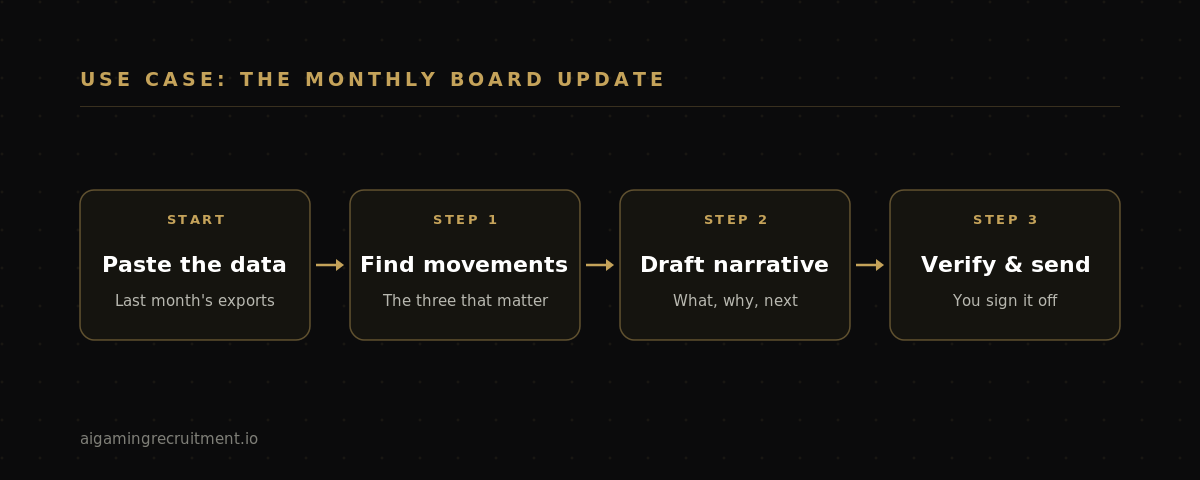
A useful prompt: “Here is last month’s paid and affiliate performance by market. Summarise the three biggest movements, explain the likely causes, and recommend where to shift 10 percent of budget next month.” You get a board-ready first draft in minutes.
Getting Genuinely Good Results
The difference between a mediocre answer and an excellent one is usually the prompt. A few habits help.
Give context and constraints up front. State your role, the market, the regulatory considerations, the audience, and what a good output looks like. The more Claude knows about the situation, the more useful and specific it can be.
Work iteratively. Treat the first response as a draft and steer it: shorter, more technical, more compliant, focus on this segment. Claude improves quickly with feedback, and the back-and-forth is where the quality comes from.
Lean on its strengths. Use the large context window by giving it whole documents rather than fragments. Use Artifacts when you want something interactive. Use Claude Code if your work genuinely touches code or data pipelines.
And verify what matters. Claude is calibrated to flag uncertainty, but no AI is infallible. Anything that touches compliance, player data, or financial reporting should get a human check before it ships. Treat Claude as a fast, capable collaborator, not an autopilot.
Want to build the skill properly? Anthropic publishes free courses on getting the most out of Claude, a good next step once you have tried it on a real task.
A Note on Data and Sensible Use
iGaming handles sensitive player data, and you should be thoughtful about what you paste into any AI tool. Stick to anonymised or aggregated data where possible, follow your company’s data policies, and never feed in personal player information you would not be comfortable sharing externally. Used responsibly, Claude is a powerful addition to your toolkit. Used carelessly, any AI tool becomes a risk.
Final Thoughts
The professionals who get the most out of AI are not the ones who hand over their judgement. They are the ones who use it to clear the busywork, stress-test their thinking, and move faster on the parts that count. Whether you are shaping a product roadmap, running a CRM calendar, or steering a marketing budget, Claude AI for iGaming can take real friction out of your day.
Pick one task from your own role, open Claude, and try it this week. The day-to-day wins add up quickly, and the habit of working alongside AI is fast becoming part of what good looks like in iGaming.
FAQ
What is Claude AI?
Claude is an AI assistant built by Anthropic, designed for reliable, well-calibrated reasoning and high-quality writing. You can use it on the web, as a desktop app, on mobile, and in the browser, so it fits whichever way you work.
Is Claude AI for iGaming better than ChatGPT or Gemini?
It depends on the task. For writing quality, long-document reasoning and coding-adjacent work, Claude AI for iGaming is a strong default. ChatGPT adds image generation, and Gemini integrates tightly with Google apps. Many professionals use more than one and pick the right tool per job.
Can I use Claude with player data?
Be cautious. Use anonymised or aggregated data, follow your company data policies, and never paste personal player information you would not be comfortable sharing externally. Responsible use keeps the upside without the risk.
What is Claude Code?
Claude Code is a terminal-based coding agent that can read a codebase, plan changes, run tests and commit them. It is useful for iGaming roles that touch data, SQL or light scripting.
How do I get started with Claude AI for iGaming?
Pick one task from your role, open Claude, give it clear context and constraints, and refine its first answer. Anthropic free courses are a good way to build the habit faster.